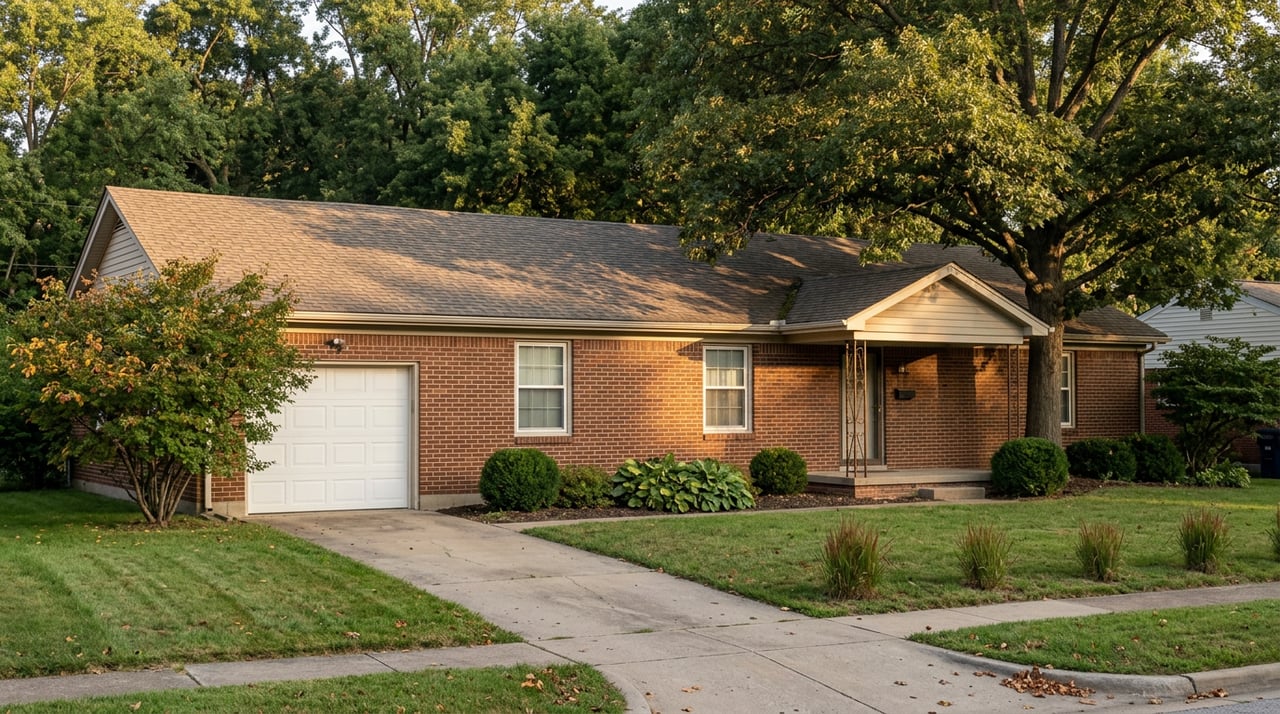
Windsor Heights is a city of a little over 5,000 people wedged between Clive and Des Moines, and most of those residents live inside the same kind of house: a brick ranch on a quarter-acre lot, built sometime between the Eisenhower and Ford administrations, on a street too narrow and tree-lined to feel like a suburb built after 1980. It's also small enough that its entire active housing inventory rarely climbs past a few dozen homes at any given moment.
That matters more than it sounds like it should, because if you check two or three sources this year for what a house in Windsor Heights actually costs, you'll get two or three different answers, and none of them are wrong. They're each describing a different handful of sales in a city that doesn't generate enough transactions to smooth its own numbers out.
Three Snapshots, One City, Three Different Numbers
Here's what shows up if you line up the last year and a half of available reporting:
| When | Source | What it showed |
|---|---|---|
| March 2025 | Rocket Homes market report | Median sale price of $270,000, with only 16 to 18 homes on the market that month |
| June 2026 | Homes.com market note | Citywide median in the high $200,000s |
| August 23, 2026 | Live MLS feed (Central Iowa Board of Realtors) | 31 active listings, averaging $302,084 |
That's not three different neighborhoods. That's the same city, across roughly seventeen months, producing numbers that move by tens of thousands of dollars depending on which handful of closings or listings got counted that particular week. Price per square foot tells the same story: Rocket Homes had it at $192 in March 2025, while current Movoto listings put the median list price per square foot at $206. None of these figures are fabricated. They're each an accurate read of a market too thin to hold one number still for long.
Why the Math Breaks in a City This Small
Statewide, Iowa sold 3,383 homes in May 2026 alone, with a median price of $253,549. When you're averaging thousands of transactions, one unusually expensive remodel or one distressed sale barely moves the needle. Windsor Heights doesn't have that luxury. As of August 23, 2026, the entire city had 31 homes listed for sale. A market report from March 2025 counted as few as 16 to 18 homes on the market that month.
When your total inventory is a number you could list by street address, a single high-end renovation closing next to two starter ranches selling as-is can swing the median by tens of thousands of dollars, purely from mix, not from the market actually getting more or less expensive. That's the pattern behind the gap between a $270,000 median in spring 2025 and a $302,084 average this August. It isn't necessarily wrong that Windsor Heights values have climbed over that stretch. It's that a number built on a few dozen sales a year is measuring which specific houses happened to sell, more than it's measuring the city's underlying value.
What's Actually Sitting on These Streets
Part of why this city is so hard to average out is that the housing stock itself doesn't vary much. Most homes were built in the 1950s through the 1970s, averaging around 1,500 square feet on quarter-acre lots. Brick ranches dominate, alongside a smaller mix of Tudor Revival cottages and two-story Colonial Revival homes, many with original plaster walls and coffered ceilings that don't show up in newer construction anywhere else in the metro.
That uniformity cuts two ways. It means comparing Windsor Heights to a fast-growing suburb full of new construction is comparing two different products, not just two different price tags. But it also means that within the city, there isn't much room for a median to hide behind variety. A four-bedroom two-story and a three-bedroom ranch pull the average in very different directions when there are only a couple dozen sales to average across, and the city has both types sitting on the same handful of streets.
The Apartment Building That's Quietly Rewriting the Comps
There's a second force working on these numbers that has nothing to do with buyers wanting a bigger kitchen. In late 2023, three locally owned LLCs paid $1.5 million for a row of houses at 63rd Street and University Avenue, land that had belonged to Windsor Presbyterian Church. The houses came down that fall to make way for The Windsor, a 105-unit mid-rise apartment building with underground parking, developed by Todd Millang, a senior vice president at CBRE's Des Moines office, and Nick Jensen, owner of Caliber Iowa. The project drew $1 million in Iowa workforce housing credits and sales tax refunds, with completion originally targeted for early summer 2025.
When a developer buys three or four adjoining houses specifically to demolish them, that transaction gets recorded in the same public data as a family buying a move-in-ready ranch down the street, but it isn't the same kind of sale. The land is worth more to a builder assembling a parcel than the house on it is worth to a buyer who wants to live there. In a market with only a couple dozen closings a year, even one or two of those land-value transactions can nudge an average price upward without a single traditional buyer paying more for a comparable home.
What This Means If You're Comparing Windsor Heights to Clive or Urbandale
If you're cross-shopping Windsor Heights against a larger, newer-construction suburb, any single month's median is close to useless for that comparison. Two better questions to ask instead:
First, what has price per square foot done across several reporting periods, not one. A city moving from $192 to $206 per square foot between spring 2025 and today is telling you the market is thin and gradually climbing, not that any one month's number should be taken at face value. Watch the trend across a full season before trusting any single snapshot.
Second, understand what you're actually buying. As of Homes.com's June 2026 market note, Windsor Heights priced below West Des Moines and Urbandale and above Des Moines citywide, largely because it offers something neither bigger suburb does at that price: a walkable, transit-served, mid-century brick ranch a short trail ride from the Clive Greenbelt, on a lot size newer subdivisions don't build anymore. That's a real trade, not a discount. You're not getting a smaller version of an Urbandale house for less. You're getting a different kind of house entirely, in a city too small to ever give you a tidy, stable number to compare it against.
A Few Questions Worth Answering Directly
Why do different websites show different median prices for the same city? Because Windsor Heights closes so few homes in a typical month that whichever handful of sales a site's snapshot happens to capture can shift the reported median by tens of thousands of dollars. It's a sample size issue, not a data error.
Is Windsor Heights actually cheaper than Urbandale or West Des Moines? On the numbers available this year, yes, generally, but the gap is noisier than any single month's median suggests. Price per square foot, tracked over several reporting periods, is a steadier way to compare.
How fast do homes actually sell here? Homes.com's June 2026 note put average time on market at about 30 days, faster than the roughly 50-day national average it cited for comparison. With inventory this thin, a well-priced ranch in good condition doesn't sit long once it's listed.
If you're trying to figure out whether Windsor Heights fits what you're looking for, or how its numbers actually compare to a specific house in Clive or Urbandale, that's a conversation better had with someone who tracks this market month to month rather than off a single headline stat. Christopher Lewis has spent years working exactly this kind of comparison across Central Iowa's smaller cities and can walk you through what the current inventory actually looks like street by street. Let's Connect.